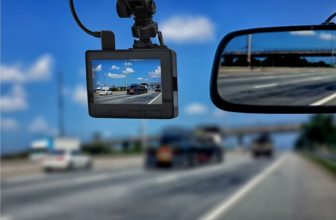
Every dashcam needs a small store of power to finish saving the last video file when you switch off the engine. That store is either a lithium battery or a supercapacitor. In a mild climate the difference hardly matters. In the UAE, where a car parked in the sun turns into an oven for half the year, it decides whether your dashcam lasts for years or gives up after its first summer.
For UAE drivers, buy a supercapacitor dashcam. Supercapacitors tolerate cabin heat far better than lithium batteries, do not swell, and keep working through years of daily heat cycles. Battery dashcams can survive if you always park in the shade, but heat is the most common reason they fail.
What a capacitor does in a dashcam
When you turn off the ignition, most dashcams lose power instantly. The camera needs a second or two to close the video file it is writing and shut down cleanly; without that, the last clip, often the one that matters, can be corrupted.
Dashcams solve this with one of two components. A small lithium-ion or lithium-polymer battery stores energy chemically. A supercapacitor stores it as an electric charge, charges in seconds and holds just enough energy for a safe shutdown.
A common misunderstanding is that a battery lets the dashcam record while the car is parked. It does not: internal batteries last a few minutes at most. Recording while parked needs a constant supply from a hardwire kit, an OBD cable or an external battery pack, whichever power store the camera has. See our parking mode guide.
Why heat matters so much in the UAE
The cabin of a car parked in the summer sun can climb well past 70°C, and the area just behind the windscreen, where the dashcam sits, gets hotter than the air in the middle of the car.
Lithium cells do not like that. Heat speeds up their chemical ageing, and repeated hot days can make a cell swell. In a dashcam, a swollen battery can split the casing, push the lens out of line or stop the camera from starting. Many battery models also switch themselves off when they get too hot, which means they are not recording when you might need them.
Supercapacitors age in heat too, but slowly, and they fail by gradually holding less charge rather than by swelling. They are also rated for hundreds of thousands of charge cycles, which suits a camera that powers up and down several times a day.
| Supercapacitor | Lithium battery | |
|---|---|---|
| Heat tolerance | High | Low to moderate |
| Swelling risk | None in normal use | Real risk after hot summers |
| Typical rated operating range | −10°C to 60°C or −20°C to 65°C in our catalogue | Often lower, or not published |
| Lifespan in UAE use | Years | Can degrade within one or two summers |
| Keeps recording if the power cable is pulled | No, saves the last clip only | Briefly, for a few minutes |
| Clock when unplugged for weeks | May reset; GPS models correct it automatically | Usually kept |
| Price | No longer a premium: most mid-range models use one | Common on budget and screen-heavy models |
How to read a dashcam’s temperature rating
Look for two numbers in the specification sheet. The operating temperature is the range in which the camera is designed to record. The storage temperature is the range it should survive while switched off. The supercapacitor models in our catalogue are typically rated to operate from −10°C to 60°C or from −20°C to 65°C.
Those ratings refer to the air around the camera. A dashcam mounted against hot glass in direct sun can sit above its rating even when the cabin air is not, which is why the mounting position and a sunshade matter as much as the spec sheet.
Some cameras have high-temperature protection that shuts them down above a set limit. That protects the hardware, but it also means a gap in recording until the cabin cools. If a brand does not publish a temperature range at all, treat that as a warning sign for UAE use.
How to protect any dashcam from the summer heat
- Mount the camera behind the rear-view mirror, in the dotted shade band at the top of the windscreen where possible.
- Use a reflective windscreen sunshade every time you park outdoors.
- Park in covered or shaded parking when you can, and avoid leaving the car in full sun with parking mode running for days.
- Use a high-endurance microSD card rated for high temperatures, and format it in the camera every month.
- Hardwire the camera with a low-voltage cut-off so parking mode never flattens your car battery.
- If you already own a battery dashcam, check it every few months for a bulging case or a camera that will not start, and stop using it if you find either.
Are there any downsides to capacitor dashcams?
Very few. A capacitor holds only enough power to save the current file, so if the power cable is ripped out in a crash the camera stops recording within seconds, while a battery model can keep going for a short time. In practice the impact itself is captured either way.
Without a battery, some capacitor cameras lose the clock if they are unplugged for a long time. Models with GPS set the time automatically from satellites as soon as they start.
The other trade-off is that many dashcams with large rear screens use batteries. If you want a capacitor, expect a more compact camera with a small screen or none at all, controlled from your phone.
Choosing a capacitor dashcam
Start with the power store, then pick the rest of the specification the same way you would for any dashcam:
- Channels. A front and rear (2-channel) camera covers most drivers; add a cabin camera for taxi or rideshare use.
- Sensor. A recent Sony STARVIS 2 sensor gives the best night footage at each price point.
- GPS. Speed, location and accurate time on every clip. See our GPS guide.
- Parking mode. Buffered parking mode with a hardwire kit is the most useful setup for mall and street parking.
- Storage. Check the maximum card size and work out how many hours you need with our SD card recording-time guide.
Browse every model in our supercapacitor dashcams category, or start with the dashcam buying guide.
Top-rated capacitor dashcams
Our highest-scoring supercapacitor dashcams, updated automatically from our reviews

VIOFO A329S 3 Channel 4K Dashcam
AED1,899.99- 4K front, 2K fisheye cabin and 2K rear — STARVIS 2 on all three cameras: IMX678 up front, IMX675 for cabin and rear.
- 210° fisheye cabin camera — covers the whole cabin with no blind spots, ideal for rideshare and family driving.
- Supercapacitor, rated −20°C to 65°C — no lithium battery to degrade in a parked car through the UAE summer.
- Energy-saving parking mode — low-power collision detection starts recording on impact; needs the VIOFO HK4 or HK6 hardwire kit (sold separately).
- Wi-Fi 6 and external SSD up to 4 TB — a 1-minute 4K clip reaches your phone in under 10 seconds; storage not included.

Vantrue N4 Pro 3 Channel 4K Dashcam
AED1,399.00- 4K front, 1080p cabin and 1080p rear — STARVIS 2 IMX678 up front with 4K HDR for readable plates day and night.
- IR cabin camera — F1.8 lens with 4 infrared LEDs records passengers clearly even in total darkness.
- Buffered parking mode — saves 10 seconds before and 30 seconds after motion; needs a hardwire kit, sold separately.
- Dual capacitors, no battery — built for extreme heat; rated −20°C to 65°C.
- 12 voice commands, 5 GHz Wi-Fi and GPS — control it hands-free and download clips in the Vantrue app.

BlackVue Elite 10 2 Channel 4K Dashcam
AED2,418.52- True 4K front and rear — both cameras record 4K at 30fps on Sony STARVIS 2 sensors, with HDR on the front camera.
- Power-saving parking mode under 1 mA — wakes in 0.89 seconds when something happens; needs the hardwiring cable, which is included.
- Supercapacitor, rated −20°C to 65°C — with high-temperature shut-off to protect the camera and its files.
- Boots in under 1 second — starts recording almost as soon as the ignition is on, even from a cold start.
- Built-in GPS, Wi-Fi and BlackVue app — with 5 GB of free cloud storage and support for cards up to 1 TB.

THINKWARE U3000 Pro 2 Channel 4K Dashcam
AED2,223.09- 4K front + 2K rear on dual STARVIS 2 sensors — Sony IMX678 and IMX675 with Super Night Vision 4.0 for readable plates and signs day and night.
- Built-in front and rear radar parking mode — low-power radar wakes the camera on movement and saves a 20-second clip; needs hardwiring or the OBD-II cable.
- Supercapacitor, rated −10°C to 60°C — no lithium battery to degrade in a parked car through the UAE summer.
- Dual-band Wi-Fi and GPS — pair with the Dash Cam Link app over 2.4 or 5 GHz; speed and location are tagged on every clip.
- Front collision and lane departure warnings — plus safety camera alerts from the built-in GPS.

VIOFO A229 Pro 2 Channel 4K Dashcam
AED1,099.99- 4K front + 2K rear on dual STARVIS 2 sensors — Sony IMX678 and IMX675, both with HDR, for readable number plates day and night.
- Supercapacitor, rated −20°C to 65°C — no lithium battery to degrade in a parked car through the UAE summer.
- Buffered parking mode — keeps 15 seconds before and 30 seconds after an event; needs the VIOFO HK4 hardwire kit (sold separately).
- 12 hands-free voice commands — lock a clip, take a photo or switch views without touching the camera.
- Quad-mode GPS and 5 GHz Wi-Fi — speed, location and time logged with every clip; download footage to your phone in the VIOFO app.

Vantrue N5S 4 Channel 2.7K Dashcam
-23% Original price was: AED1,549.00.AED1,189.96Current price is: AED1,189.96. -23%- 4 cameras, 360° coverage — 2.7K front, 2.5K rear and two 1080p cabin cameras covering the road, the cabin and the back seats.
- STARVIS 2 on all four cameras — with HDR/WDR, and infrared lights on both cabin cameras for full darkness.
- Supercapacitor, rated −20°C to 60°C — built with heat-resistant materials for extreme climates.
- Buffered parking mode — 10-second pre-recording on motion plus collision detection; must be hardwired (kit sold separately).
- 5 GHz Wi-Fi, dual GPS and voice control — manage clips, speed and route in the Vantrue app, or by voice.